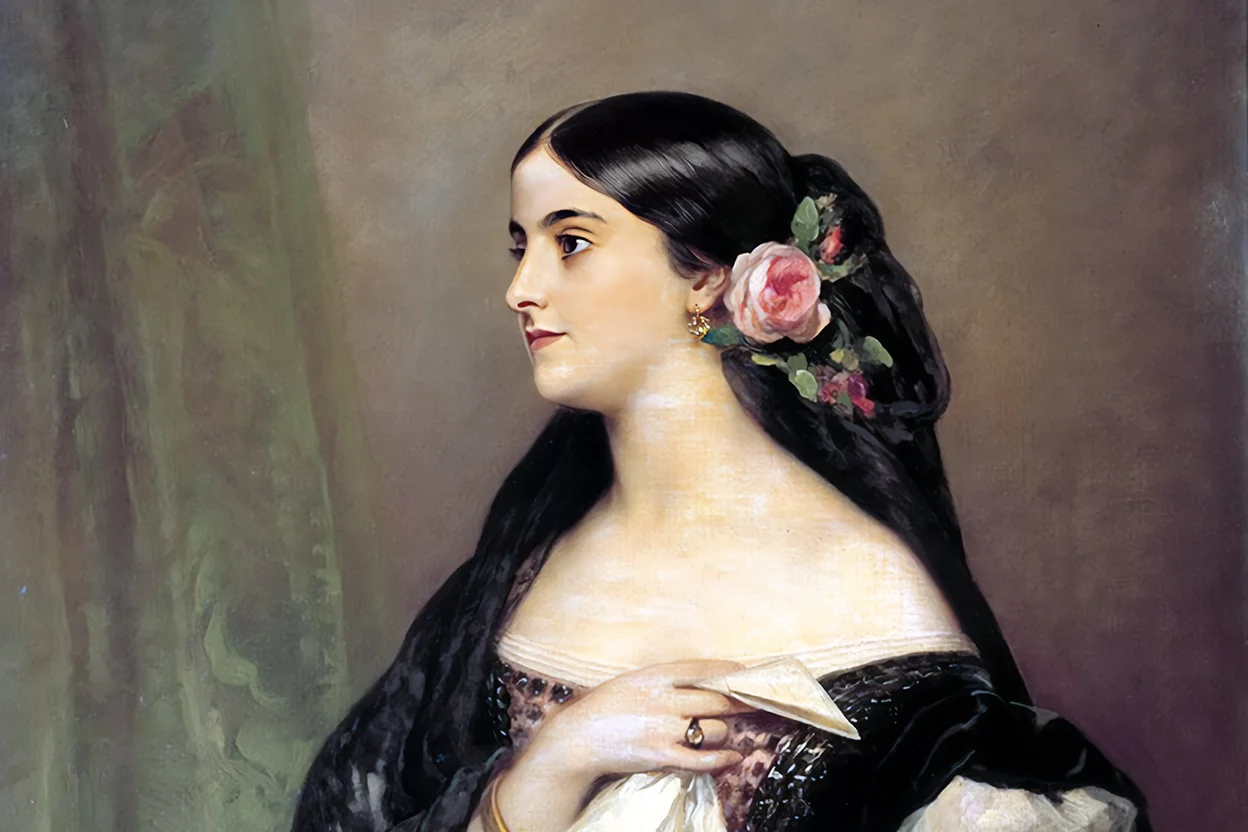
In March 1886, Lisbon panicked. The world's greatest opera star was about to arrive at the São Carlos Theatre, but tickets sold out in 48 hours, and rumors circulated about her decline. At 43, could Adelina Patti still enchant audiences? The city was divided between adoration and skepticism.
On the morning of March 25, 1886, while Adelina Patti was already savoring the fillets that João da Mata had prepared for her at the Grande Hotel, the persistent rumor that she wasn't coming still circulated on Avenida da Liberdade. The anxiety was such that the city of Lisbon refused to believe its own fate. Adelina Patti was not just an opera singer. She was the superstar of her time, the first modern celebrity in the sense we recognize today: adored, criticized, envied, scrutinized in detail.
At 22, she had already sung for all the European sovereigns. At 43, when she arrived at the Royal Theatre of São Carlos, she carried with her a fame as heavy as the diamonds she studded on her dresses. And Lisbon didn't quite know what to do with her.
The panic of the forty-eight stories
Between October 1885 and March 1886, Lisbon's music lovers lived in a kind of collective anxiety. Five Patti performances were announced for November. The São Carlos theater sold out in forty-eight hours. Forty-eight hours for tickets sold at exorbitant prices—each costing around twenty thousand réis—to disappear.
A parallel market developed, and scams of all kinds emerged. Gervásio Lobato, insightful columnist for the magazine. The West, He summed up the general feeling: it was a mixture of amazement and resentment, that feeling of being deceived while at the same time not wanting to miss the opportunity.
But November arrived and Patti didn't show up.
A cholera epidemic was spreading across Europe. Quarantines were multiplying. In the Portuguese Parliament, deputies panicked and discussed the "tent" on Avenida da Liberdade where they were collecting those who crossed the Spanish sanitary cordon, barely concealing their fear for their own lives. Adelina Patti made it known that she would not act while quarantines were in place.
Contributing to the delay was also the scandal of her divorce. Her marriage to the Marquis de Caux had collapsed, the separation had been granted in 1877, and the divorce finalized in 1885. Patti had lost half her fortune. Therefore: anger, scandal, money. Enough reasons to make a diva wait.
The diva who drank Château Margaux at lunch.
When Patti finally arrived, the gossip press reported every detail with a meticulousness that we would now recognize as pre-tabloid. The glass of lukewarm water she ordered as soon as she entered the hotel. The detailed menus. Her exclusive preference for Château Margaux. The state of her throat, her stomach, the rheumatic pain in her knee that bothered her.
João da Mata, owner of the Grande Hotel, strove to satisfy all the whims of the celebrity who, with his presence, attracted attention to the establishment. For lunch: rice broth, Chateaubriand-style sirloin steak, spinach, asparagus, boiled fish, roast chicken, apple compote. For dinner, served around seven in the evening: pasta soup, boiled fish, English-style steak with potatoes, English-style peas, roast chicken.
All of this was reported. All of this was read avidly.
Casimiro Dantas, another chronicler of the time, described the reaction of high life A Lisbon native could describe her with three words: "madness," "delirium," and "nervousness." There was something hysterical in the attention the city devoted to that 43-year-old woman who had come to sing opera.
Fidès against Adelina: the divided city
The problem was that Lisbon already had its diva. Fidès Devriés reigned at the São Carlos Theatre, adored by an audience that was now preparing to betray—or not—its loyalty. The tension was palpable.
On the other hand, rumors circulated about Patti's artistic decline. In Barcelona and Valencia the previous year, she had been booed. Not for singing badly, Lobato clarified, but for the obscene ticket prices. The audience had booed the manager, not the diva. Or perhaps they booed both—the accounts differed.
Claude Augé, in the French magazine Larousse Mensuel Illustré, She recounted that in Valencia, when she refused to sing "Il Bacio," Patti received the first booing of her career. It was in Madrid that the doubts vanished. Right from her first performance, she triumphed, acclaimed in a "loud and unanimous" manner.
António de Campos Valdez, the manager of the São Carlos theatre, breathed a sigh of relief. But Lisbon remained skeptical.
The night of March 27th
On opening night, the São Carlos theater was overflowing. The crowd was preparing to confirm or deny the fame of the artist who had started her career in the United States and was now causing a sensation in Europe.
The tension was enormous. Patti sang and performed Rossini's "Il barbiere di Siviglia" astonishingly well, but the audience remained cold, almost hostile. As Lobato observed, they adored Fidès Devriés, and their cult following seemed to forbid them from cherishing another idol.
It was only in the third act, while singing the waltz from Meyerbeer's "Dinorah," that Patti received her first round of applause. She finished in apotheosis with Luigi Arditi's "Il Bacio"—the same song that had earned her boos in Valencia.
It was a resounding triumph. Almost unanimous. The press was full of praise for Patti's first performance at the São Carlos Theatre.
Diamonds, gold, and the art of being hated.
What Adelina Patti aroused in Lisbon — and everywhere she went — were profoundly contradictory feelings. Admiration for the singer, hatred for the woman. Fascination with her elegance, repulsion for her ostentation.
Dantas captured this ambivalence well in a column: the admiration for Adelina the singer stifled "a few petty hatreds for Adelina the woman" and impelled the columnists to her rooms "where there is a stunning perfume of violets and expensive essences, an atmosphere saturated with fine and intoxicating aromas.".
The ostentation was deliberate. In 1861, when performing "La Traviata" in Covent Garden, she wore a dress with diamonds embedded in the bodice—valued at 200,000 pounds. She hired two policemen to join the chorus and guard the dress.
She was probably the highest-paid singer in the history of opera. Five thousand dollars a night—about 143 thousand dollars today—always in gold, delivered to her dressing room before she sang.
Comments in Lisbon about the ticket prices, given the already strained financial capacity of even the wealthiest Lisbon residents, were immediate. One columnist summed up the situation with biting irony: bringing Patti to the festival cost fortunes to those who "just to put on the gloves of..." suede, "He sadly eats coffee with milk straight from the pitcher for lunch.".
The split verdict
The debate in the press was heated. For some, his performance was unquestionable. For others, his age was showing in his voice.
“There were pessimistic rumors circulating that Patti was entering a period of decline,” wrote Lobato. “Her first performance in Lisbon was a brilliant refutation of these false rumors, a triumphant affirmation of the complete fullness in which her privileged artistic gifts still reside.”
Dantas was more cautious: “If you tell me that Patti was a brilliant and amazing singer, I believe it wholeheartedly (…) and in the manner of the remarkable artist, in her singing method, in her phrasing, in her style, in the timbre of her voice, there are still reflections of a first-rate star.”
Reflections of a star. Not the star itself. The wording was delicate, almost cruel.
The train that took the diva
When she left, “numerous admirers of the famous singer came to the station to say goodbye.” She would spend two days in Paris — she needed “the services of her dentist to polish her teeth” — before heading to the castle in Wales.
The dentist's details were reported. Like everything else.
Adelina Patti left Lisbon as she had arrived: enveloped in admiration and resentment, adored and hated, acclaimed and scrutinized. She was the first superstar in the modern sense of the word—not just for her fame or talent, but for the way the public related to her: consuming every detail of her life, dividing themselves into factions, paying fortunes for tickets, heatedly debating whether she was still worth it.
Lisbon sold out tickets in forty-eight hours. Then months passed debating whether it had been worth it. It is, perhaps, the perfect definition of a superstar: someone who makes us question whether the glamour is worth the cost, while we remain, irremediably, dazzled.